
New products in convenience retail: the award is only the start
Between 6 and 9 December, the German trade title Convenience Shop names the winners of Convenience Best 2024 in five categories. For the FMCG brand owners involved, that verdict is welcome news. The harder question starts the day after: what becomes of an award-winning launch on its way from the listing agreement to the till receipt?
Five categories, one expert verdict
Convenience Best 2024 recognises new products in tobacco, e-cigarettes, drinks, foodservice, and snacks and confectionery. Red Bull, Beam Suntory and Pernod Ricard take the drinks category, Backunion and Bakerman lead in foodservice, and KoRo, Hitschler and Barcel/Dan Cake win in snacks and confectionery. Individual winners such as the 0.25 litre Red Bull Pink Edition, Hitschies Saure Drachenzungen and Takis Dragon Sweet Chili show where the assortment is heading: small pack sizes, bold flavour cues and a high impulse share.
An award measures the potential of a product. What that product achieves on the shelf is settled weeks later and somewhere else entirely, in more than 14,000 German forecourt sites that each decide for themselves about space and attention.
Listing is permission, placement is a decision
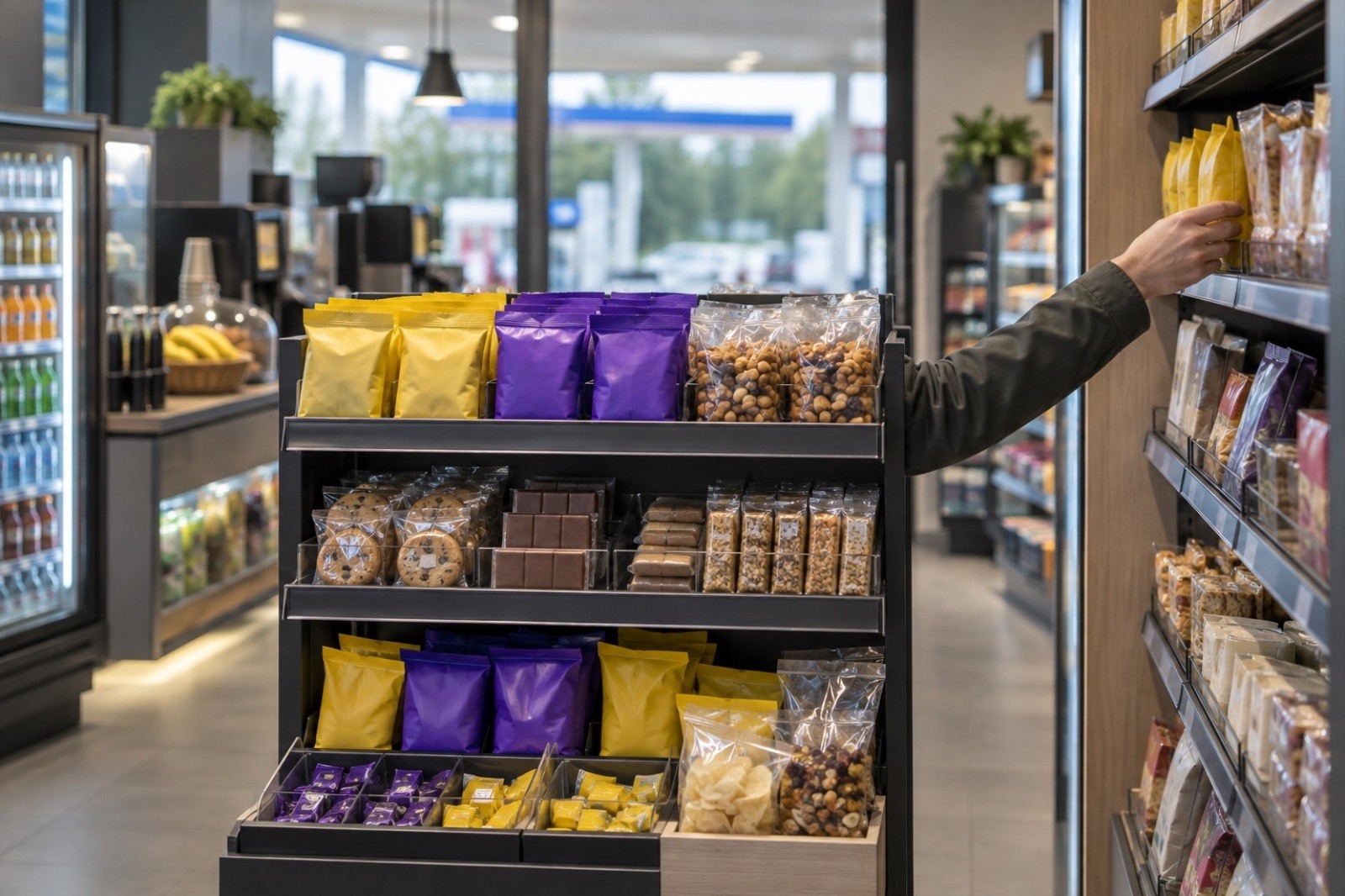
A listing states that an item may be ordered. It says little about whether the item stands in the shop, where it stands, and whether the shopper ever sees it. On the small floor area of a forecourt shop, every new product displaces something else, and space along the main traffic route is the scarcest resource the site has.
That makes the operator a co-author of the result. He allocates the facing, he builds the secondary placement or leaves it in the carton, he reorders or waits for the next delivery run. The same launch therefore produces two entirely different outcomes: full visibility at one site, an out-of-stock at the next. Both later appear in the sell-out data as a property of the product, when they are in fact a property of execution quality.
Buying in a forecourt shop follows its own rules
Shopping at a petrol station works differently from a weekly grocery retail trip. Dwell time is short and the shopping mission is narrow: something to drink, something for the journey, something for right now. Impulse buying carries far more weight here than in the weekly shop, and the decision happens in passing.
A new product therefore needs three things at once: a place on the main traffic route, a recognisable block within its category, and a message that lands in a few seconds. Miss one of the three and the award stays a win on paper.
What the operators themselves report
On 9 December, Convenience Shop publishes a survey of forecourt operators carried out by Bormann & Gordon, under a headline that translates as "new products matter to us". The answers cover a wide range. Some sites bring novelties onto the floor early and work them actively. Others wait until sell-out convinces them, and give the newcomer whatever space happens to be free.
That range is the real story for brand owners. It explains why an identical launch performs strongly across one network and barely registers across the next. Since 2004, the B&G Shopper Monitor Tankstelle has surveyed both sides of the counter: the customers at the point of sale and the operators who decide about the floor every day.
One wholesaler, four networks
At the same time, the balance of power in the channel is shifting. Since October 2024, Lekkerland has supplied the roughly 800 Jet sites; around 140 Sprint shops follow on 1 January 2025, and Edeka Foodservice withdraws from the segment. One wholesaler now serves Aral, Esso, Shell and Jet in parallel.
For manufacturers that means fewer doors and more weight in every negotiation. Anyone who wants to convince at that table brings evidence about execution, rather than evidence about the idea alone. Cost pressure inside the shops sharpens the demand further: from January, a minimum wage of 12.82 euros and a carbon price of 55 euros per tonne apply, so every shelf metre is judged on its contribution.
Three figures that settle the argument
Success of a launch breaks down into three measurements, all of which arise at the point of sale: availability, placement, and sell-out against a control group. A baseline measurement before the launch, store checks during the introduction phase, and a match with scanner data separate cleanly what the product achieved from what its execution achieved.
That is the work Bormann & Gordon does across roughly 30,000 store visits a year. Anyone planning to optimise a launch into the convenience channel in 2025 does best to plan the measurement alongside it. We are glad to discuss a suitable test design.