
From Trade Fair to Shelf: What Actually Reaches the Shop
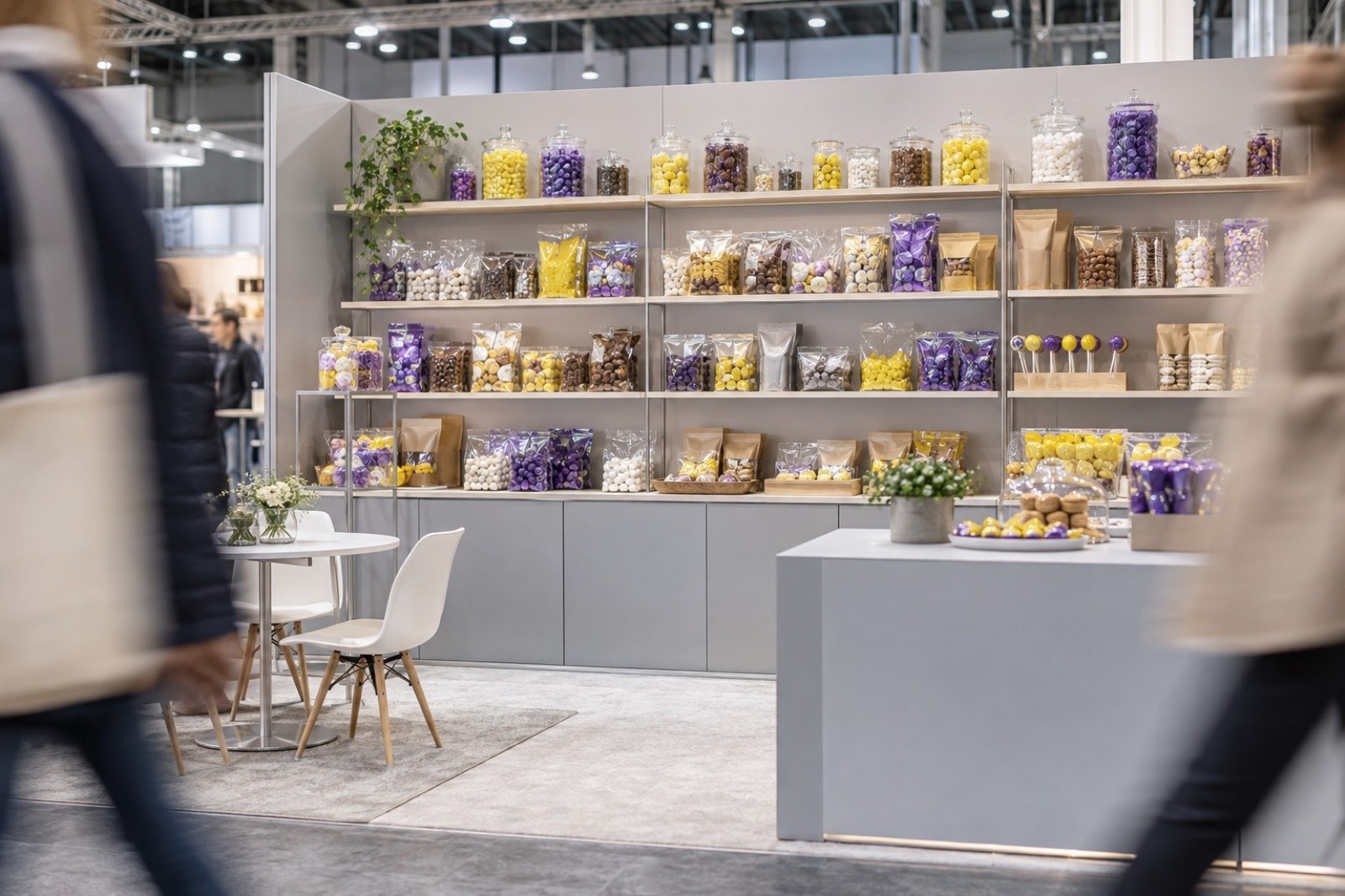
The confectionery year opened in Cologne in early 2026. Koelnmesse counts 1,790 exhibitors from 75 countries and some 32,500 trade visitors from 140 countries; the trade press reports around 1,600 exhibitors from 72 countries. Both figures describe the same picture: an abundance of new products. The more interesting number appears in no trade fair report.
Between the hall and the shelf sits a funnel
A new product that wins people over on the stand has completed the first of four stages. Next comes the listing with the retailer or the convenience wholesaler. Then the placement decision: main shelf, secondary placement, checkout zone. Then execution in the individual store or forecourt site. And at the very end stands the question that decides sell-out: does the shopper see the product during the few seconds spent in that aisle?
Each stage passes on fewer candidates than the one before. Of the lines that impress in February, some win a listing, fewer win a good position, and fewer still win the visibility that turns a listed item into a bought one. The trade fair shows the potential. It is earned a few hundred kilometres away, at the shelf.
"We have the listing. What does the store look like?"
That question comes up in every second annual negotiation, and it is a fair one. A listing is a commitment from head office. What becomes of it on the shop floor depends on facings and block formation, on the position in the customer flow, on availability during the promotion week, and on the plain question of whether the display unit really went up on the agreed date.
This is where the gap between planogram and realogram opens. Panel data reliably show what was sold. Whether the product stood visible on the day of sale is shown by field measurement alone. Bormann & Gordon carries out around 30,000 store visits per year for exactly this purpose, alongside continuous secondary placement tracking with photo, location and time stamp.
In convenience retail, centimetres decide
In a forecourt shop or a kiosk the arithmetic tightens. On a small floor area every placement is also a displacement: whatever goes on the counter takes the space of something else. The checkout zone is the scarcest space in German retail and the most sought after at the same time, because that is where impulse purchases happen.
On top of that comes the shift the channel has been living with for several years: the impulse purchase is moving from the bar at the till to the mini meal in the chiller. A confectionery launch now competes with sandwiches, coffee and snack boxes as well. Anyone planning a range in February is well advised to plan the space it will occupy at the same time.
Effect can be measured before the season starts
For the question of whether a new line carries its space there is a clean procedure: baseline measurement, defined test stores, a comparable control group, evaluation against sell-out data. That separates genuine incremental volume from cannibalisation within your own range, and it produces a figure that holds up both in the annual negotiation and in front of your own management board.
Spring is the best moment for it, while the autumn listing round is still open. A result in summer sets the priorities for the most important secondary placement season of the year, and it sets them with numbers rather than expectations.
Looking ahead
EuroShop opens in Düsseldorf at the end of February, this year marking its 60th anniversary. Its subjects are store design, checkout technology, electronic shelf labels and artificial intelligence, in other words the stage on which the Cologne launches will later stand. Taken together, the two trade fairs describe the year rather precisely: first the product, then the place.
Bormann & Gordon has been working on the second half of that equation since 1972. How a specific new product performs at the point of sale is best established by a test under real conditions. We are happy to discuss the right design for yours.